


Last updated: August 5, 2026 · Reading time: 6–8 minutes
Observability vs. Monitoring: Two terms that are constantly used interchangeably in everyday IT, but don’t mean the same thing. We’ll break down the etymology, cite the earliest known definition from 1959, and use OpenTelemetry and Graylog to demonstrate how these two concepts interact in practice.
The term observability is on everyone’s lips and is often touted as a modern solution to dusty old, static monitoring. All manufacturers offer it, all users need it, preferably a lot and right now.
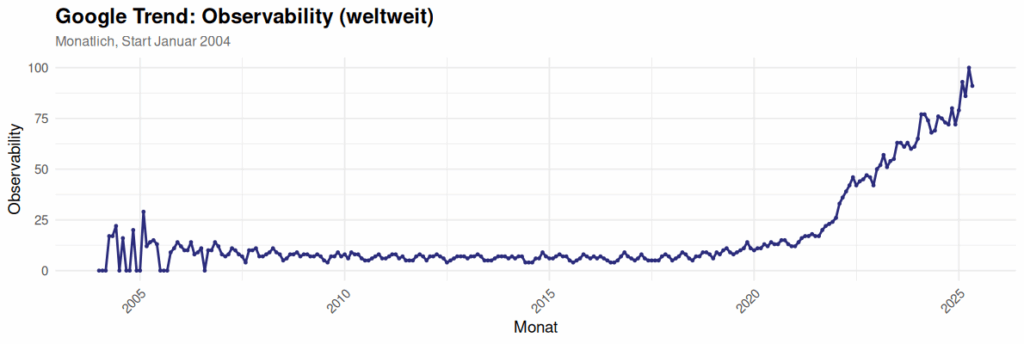
However, if you read through product descriptions and blog posts on this topic, you’ll notice that there isn’t really a single, uniform definition of the term.
What do I mean by that? Depending on what you’re reading, observability is sometimes described as “an approach to improving observability,” “an element of modern IT infrastructures,” “understanding a system’s status based on its output,” “a process for detecting disruptions,” or “a property of a system.”
Of course, terms like to change their meaning depending on the context, but it seems to me that this term is already very overloaded. Even Wikipedia throws its hands up in the air and writes: “The definition of observability varies by vendor”.
As a trained linguist, I can’t just ignore that! Let’s try to define the terms observability and monitoring a little more precisely. Time for some etymology!
Observability
Observability is, first and foremost, a compound word derived from the English terms: “observe” (English “Verb” ( to observe) and “ability” (English noun, ability). The result is a noun, because in English most compounds get their meaning from the rightmost word (right-headed, for the linguists in the readership). As in German, by the way, the Danube steamship captain is also a captain and not a Danube.
Observability therefore describes the ability to observe something. Incidentally, the term is not new and was first used in 1959:
Observability is a measure of how well internal states of a system can be inferred from knowledge of its external outputs.
Kalman, Rudolf. “On the general theory of control systems.” IRE Transactions on Automatic Control 4.3 (1959): 110-110.
What’s interesting here is that Kalman describes observability as a “measure” (noun, unit of measurement)—that is, a unit of measurement for how well one can determine the state of a system. Even though the context back then did not refer to IT systems as we understand them today, a similar meaning can be found in many current texts.
It’s a little odd—the term includes the word “ability,” but here it refers to a unit of measurement. Unfortunately, that’s sometimes just how it is with language, and “Obsermeasure” doesn’t roll off the tongue very well either. Be that as it may, this meaning is at least tangible and clearly defined. So if observability is a skill and or measure, who possesses that skill or measure? Are we expressing the “degree of observability” of our system, or are we describing our ability as operators to observe the system?
My theory: it’s both. Let me explain: Our system (IT infrastructure or software) has a “level of observability. “ If this is “higher,” then we, as operators of the system, also have a greater ability to observe the system. A concrete example:
Let’s imagine we have an application that currently doesn’t write any logs. If we extend the application with a logging feature, its degree of observability and our ability to observe it increases. Or in short, the application and we have more observability. If we add further features, for example if our application also provides performance metrics, the observability increases again.
OK, so far so good. But what do we do now with all this observability that our system has? For example, we can analyze the data collected in the event of a failure. This can be a reactive process: I see smoke coming from the data center and then look for the cause.
But also proactively: I regularly check the temperature before the fire starts.
In my opinion, this is where the term “monitoring” comes into play. So let’s put on our linguistics lab coats again.
Monitoring
“ Monitoring” is either the noun form of the English verb “to monitor” (to keep an eye on) or its past participle. In our context (IT infrastructure), the term usually appears as “IT monitoring . ” We can therefore assume that this is the noun form.
This refers to the monitoring of IT systems or the process of monitoring. Monitoring is also not a new term. A quick search reveals this quote from a 1963 mainframe manual:
In addition […] there are large operational questions which will need to be determined in the areas of reliability, error detection, programming system and hardware maintenance under conditions of nearcontinuous operation, automatic traffic and performance monitoring, and automatic accounting.
The compatible time-sharing system: a programmer’s guide. MIT Press, 1963.
Monitoring refers, first and foremost, to everything related to the monitoring of IT systems. The term is often additionally qualified, as in the quote above “performance monitoring”, i.e. the monitoring of performance. Other examples are “status monitoring”, “service level monitoring” or “end-to-end monitoring”.
What is striking here is that this monitoring is always defined by us – the operators. What is meant by this? We define which status is good or bad, what the service level should be, or what the two ends in the “end to end” are. We also define which data is used for monitoring and which metrics are relevant for performance monitoring, for example.
This is precisely where the interplay between the terms monitoring and observability becomes apparent. Our system needs a certain degree of “observability” so that we can carry out “monitoring” in the first place. As soon as we have data and define monitoring based on it, we do monitoring.
The origin of the observability of the system should not be determined strictly on the basis of specific data. You often read: “Metrics + Logs + Traces = Observability”, but this statement limits the term far too much. Observability should include any type of data that increases the observability of a system.
Do you have observability and monitoring in-house?
Our consultants provide support in setting up monitoring and observability solutions based on open source!
Request consulting →
Practical Applications of Observability vs. Monitoring
Okay, enough theory! Let’s take a look at whether my analysis is suitable in practice. Of course, I choose the appropriate examples myself, as a proper scientist would do.
Let’s take the OpenTelemetry project as an example and apply these terms. OpenTelemetry is, among other things, API definitions and SDKs for various programming languages to generate telemetry data. For example, metrics, logs and traces. The smart thing is that we all agree on a standard for how this data is mapped and transferred.
We’ll grab the appropriate SDK and build a feature into our application that generates metrics and logs. This communicates the application in OpenTelemetry format with the OpenTelemetry protocol. So we increase the observability of the system because we now have more data to observe the state.
But data alone does not get us anywhere. So let’s install the Grafana Stack, for example, to save and analyze the data. To do this, we’ll log in to the Grafana web interface and create a few cool dashboards. This allows us to monitor the status of our application using data that we have defined as important. We do monitoring.
We can do the same with log management software such as, for example, Using Graylog (Fun Fact: Graylog also supports OpenTelemetry starting with version 6.2). Let’s imagine that we don’t yet have any insight into our server and network infrastructure logs, so our observability is still low. If we now start to collect the data centrally, we increase observability. In the Graylog web interface, we then create some notifications for alarms (too many incorrect login attempts, for example). We define which data is relevant for monitoring, so we do monitoring.
Works quite well, doesn’t it? Sure, meaning depends on context, but at the same time, having different definitions for terms in the IT industry isn’t helpful. When I say “software”, we all know what I mean. We should have a common vocabulary so that we mean the same thing when we talk. Statements like “the definition of
