

Gitlab
Accelerate your development process
With GitLab, you can efficiently manage and automate your code projects. Host your Git repository, set up CI/CD pipelines and optimize team collaboration – for software that is created faster and more securely.

From the idea to a running GitLab environment
You don’t have to build Gitlab alone. We accompany you step by step – and stay by your side afterwards.

Analysis & Concept

Setup & Integration

Commissioning & visualization

Support & Operations
Gitlab Features
From the first line of code to deployment on one platform: GitLab bundles version control, automated pipelines and team collaboration – so that you can deliver software faster and more securely.

Git repository management

CI/CD pipelines

Collaboration & code review

Security & Compliance

Integrated project management

DSGVO compliant
Gitlab web interface
The screenshot shows an overview of the GitLab web interface, in which the various components and functions of the dashboard are clearly explained.
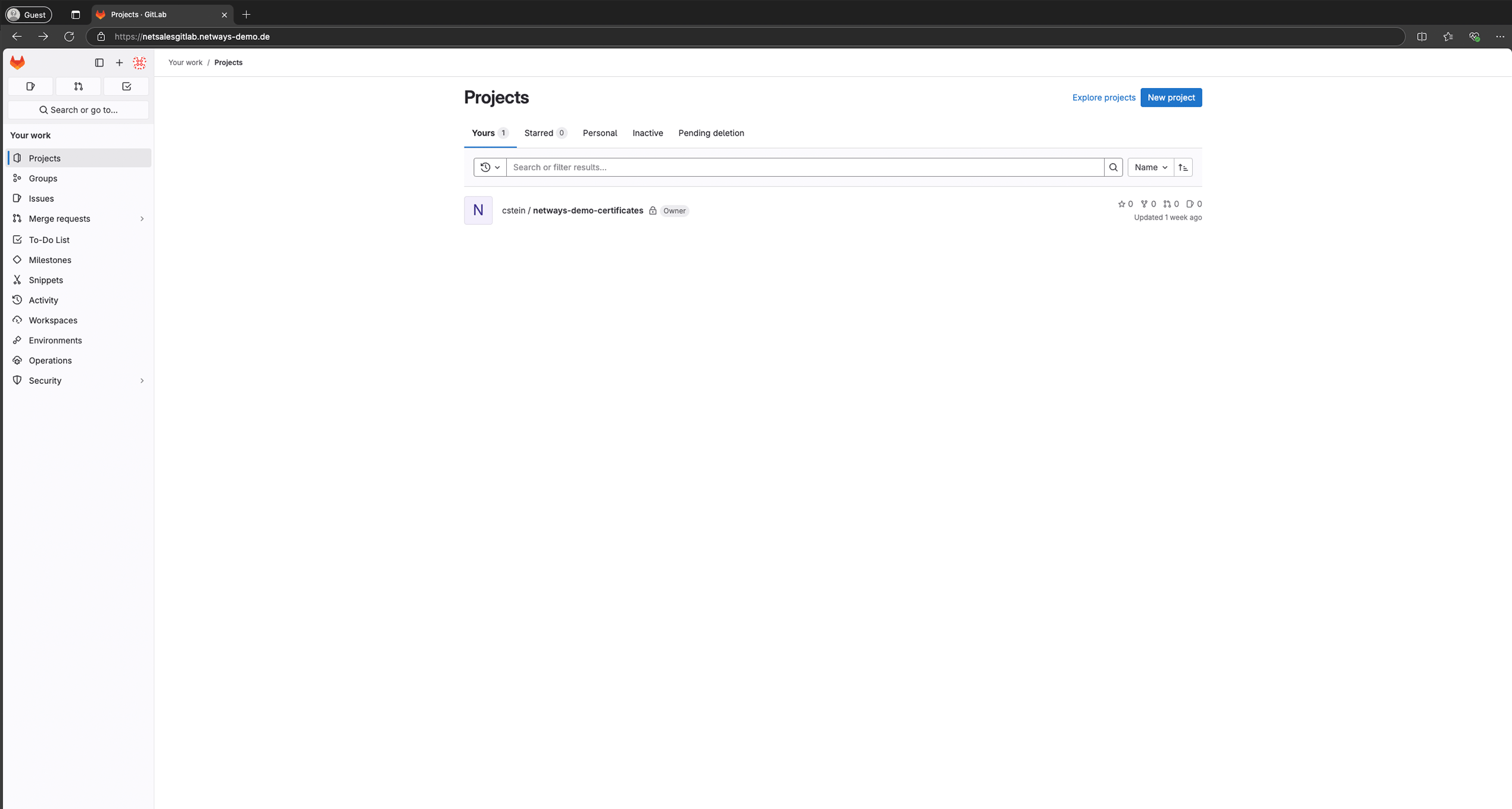
Manage all your projects in one interface.
Navigate quickly through the menu to reach the most important elements.
Use individual accounts for granular authorization management.
Add new projects quickly so you can start working straight away.
Shaping IT together
We help you to strategically plan, technically implement and sustainably operate modern IT and monitoring solutions. We combine consulting, implementation and support to create a tailor-made service that is geared to your requirements. Our aim is to make complex systems transparent, stable and efficient to use.
GitLab Training
Discover the all-in-one solution for version control and DevOps collaboration
In this GitLab training course, participants will gain a sound insight into the basics of Git, its configuration and the use of shell and GUI clients. They will also learn how to use GitLab, from repositories, issues and releases to conflict resolution in various branches.
Managed GitLab
Accelerate your development processes in the blink of an eye
Managed GitLab allows you to concentrate fully on your core business. This allows you to develop and deploy your software faster and more efficiently. We take over the entire operation of your Managed GitLab and take the pressure off your IT. Our hosting is fully GDPR-compliant and takes place exclusively in Germany – updates included!

GitLab Expertise
Want to dig deeper? You might find these blog posts about GitLab interesting.
Infrastructure as Code (IaC): Fundamentals, History, and Practical Applications of Ansible and GitLab
Introduction The way in which IT infrastructure is provided and operated has changed significantly in recent decades. In the early years of system administration, everyday life consisted of manually installing individual servers, importing software packages, editing...
Questions & Answers
The most frequently asked questions about GitLab
What do you do with GitLab?
GitLab is used to manage source code in repositories, perform version control and enable collaboration in software projects. It provides CI/CD pipelines to perform automated builds, tests and deployments, which accelerates software development and delivery. In addition, GitLab provides tools for code reviews, issue tracking and project management to make the entire development process more efficient.
Is GitLab free of charge?
GitLab offers a free version known as "GitLab Free" and includes many core features such as version control, CI/CD and basic project management. However, there are also paid plans such as "Premium" and "Ultimate", which offer additional features such as extended support, advanced security tools and advanced management functions. For private, self-hosted installations, the free GitLab Community Edition is available, which also covers many basic functions.
How much does GitLab cost?
GitLab offers a free version called "GitLab Free", which covers basic functions such as Git repository management, CI/CD and project management. There are paid plans for extended functions: "GitLab Premium" and "GitLab Ultimate". These plans include additional security and compliance tools. Prices can vary depending on requirements and company size, and there are special offers for educational institutions and open source projects. Simply contact us and we will find the right model for you.
What is GitLab simply explained?
GitLab is a platform that allows developers to save, share and collaborate on their code. It helps to track changes to the code, carry out automated tests and deployments and organize projects. This enables teams to work together efficiently and develop their software faster and more securely.
What is a GitLab server?
A GitLab server is an instance of GitLab that is hosted on a dedicated server or in the cloud and enables developers to manage their projects and repositories centrally. It offers the infrastructure to provide GitLab functions such as version control, CI/CD and project management. The dedicated hosting option gives you full control over data, security and system configuration.
What is the difference between Git and GitLab?
Git is a distributed version control system that makes it possible to track and manage changes to code locally without having to rely on a central server. GitLab, on the other hand, is a platform that hosts Git repositories and provides additional functions such as project management, CI/CD pipelines and code review tools. While Git is used for the local management of source code, GitLab extends this functionality through central collaboration and automation in software projects.
How do you work with GitLab?
To work with GitLab, you first create a repository in which the source code is stored and use Git to track changes locally and upload them to the GitLab repository. Teams can work together on projects by creating branches for different functions or bug fixes and checking and merging the code via merge requests. In addition, CI/CD pipelines can be set up to execute automated tests and deployments directly after each commit.
Who is behind GitLab?
GitLab was originally developed by Dmitriy Zaporozhets and Valery Sizov from Ukraine and published as an open source project in 2011. The company GitLab Inc. was later co-founded by Sid Sijbrandij and is now a global company with a fully distributed team. GitLab has developed into one of the leading DevOps platforms and is used by an active open source community and many well-known companies worldwide.
Who owns GitLab?
GitLab is owned by GitLab Inc., which was co-founded by Sid Sijbrandij and has been listed on the US stock exchange NASDAQ since 2021. Although Sid Sijbrandij has a significant role and involvement as CEO, investors and shareholders also own shares in the company. As a result of the IPO, GitLab is now a public company supported by a large number of institutional and private investors.
