

InfluxDB
Time series database
InfluxDB is an open source database specifically for time series data. Collect metrics and events from sources such as IoT devices, applications or infrastructure and efficiently query large amounts of data in real time.

From the idea to the running InfluxDB stack
You don’t have to build InfluxDB alone. We accompany you step by step – and stay by your side afterwards.

Analysis & Concept

Setup & Integration

Commissioning & storage

Support & Operations
InfluxDB Features

Time series under control

Powerful queries

Integration & scalability

Resource-saving & fast

Own dashboards

Own dashboards
InfluxDB web interface
The screenshot shows an overview of the InfluxDB web interface, in which the various components and functions of the dashboard are clearly explained.
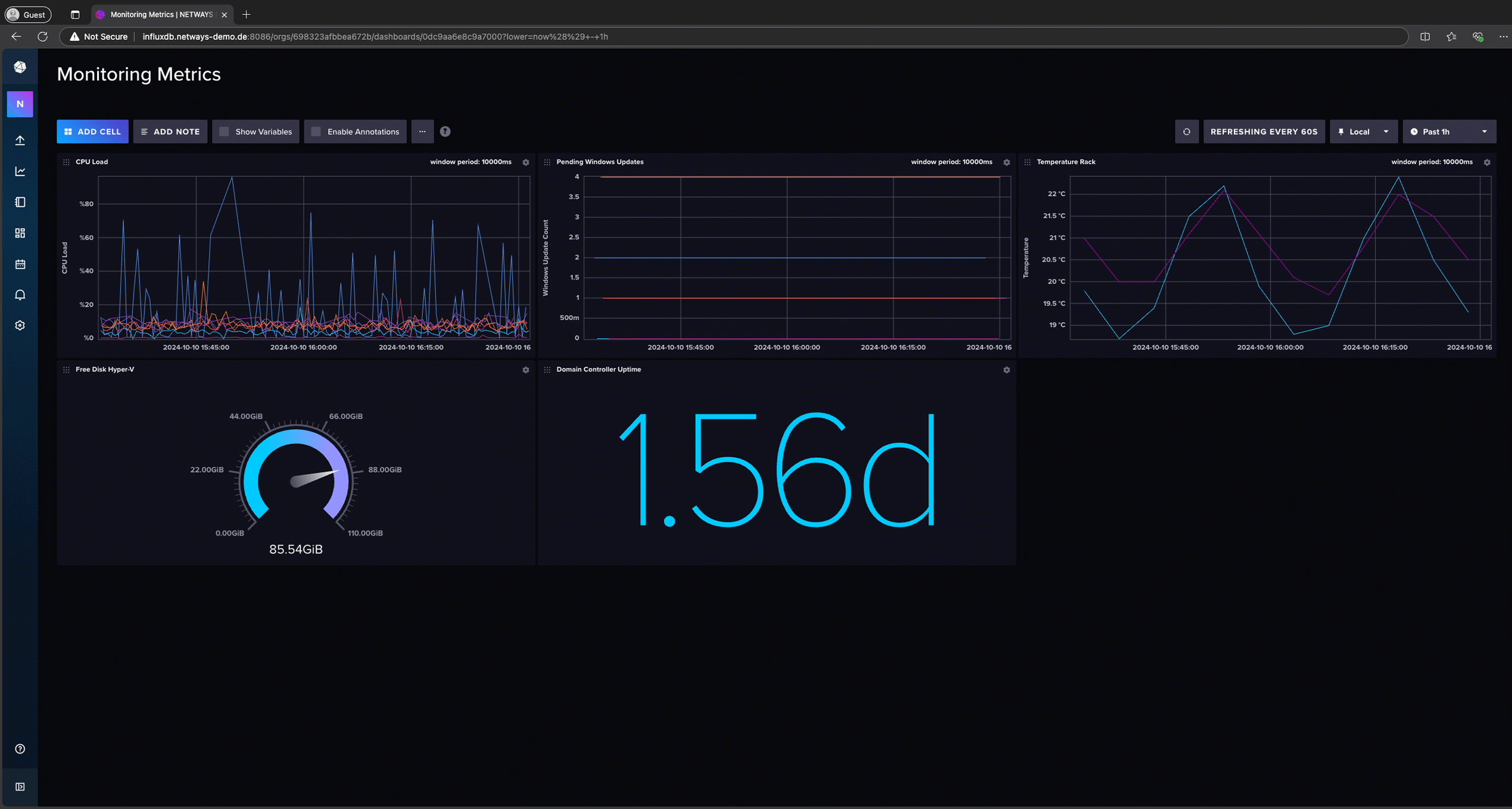
Quickly create your own dashboards and views directly in InfluxDB Web.
Visualize your metrics with a classic line chart.
The gauge diagram can be used to compare the current value of metrics with a minimum and maximum value.
Configure the current time periods in which data should be displayed with just a few clicks and activate an automatic update after defined intervals.
Configure new dashboards, create queries with your data or configure some basic settings in InfluxDB.
Shaping IT together
We help you to strategically plan, technically implement and sustainably operate modern IT and monitoring solutions. We combine consulting, implementation and support to create a tailor-made service that is geared to your requirements. Our aim is to make complex systems transparent, stable and efficient to use.
Questions & Answers
The most frequently asked questions about InfluxDB
What is InfluxDB?
InfluxDB is an open source database that is optimized for time series data such as metrics, events or sensor data. It was developed to efficiently store and process large amounts of timestamp data. With InfluxDB, data can be recorded and queried in real time.
What is InfluxDB mainly used for?
InfluxDB is often used in areas such as IoT, DevOps monitoring, application performance monitoring and financial analysis. It enables the collection and analysis of time series data from various sources in order to identify trends or monitor anomalies. It is particularly suitable for applications that process large quantities of time stamp data.
How does the data query in InfluxDB work?
InfluxDB uses InfluxQL, a SQL-like query language, to query data efficiently. Aggregations, mathematical operations and time window queries can be performed to gain deeper insights into the data. These queries are useful for creating dashboards or triggering notifications.
How does InfluxDB differ from conventional relational databases?
Unlike relational databases, InfluxDB was developed specifically for time series data, making it more efficient to store and process large amounts of time-based data. InfluxDB dispenses with the complex schema management of relational databases and concentrates on optimizing metrics and event data. This makes it faster and more resource-efficient when processing time series data.
Can InfluxDB be operated in real time?
Yes, InfluxDB was developed to collect, store and query data in real time. It can be used to continuously collect data from IoT devices, servers or other sources and instantly analyze or visualize it. This makes InfluxDB ideal for monitoring and alarm applications.
How can InfluxDB be integrated into existing systems?
InfluxDB can be easily integrated with other tools such as Grafana for visualization and Telegraf for data collection. It also offers REST APIs and client libraries for various programming languages to insert or query data. Thanks to this flexibility, InfluxDB can be integrated into almost any infrastructure, such as Icinga.
